
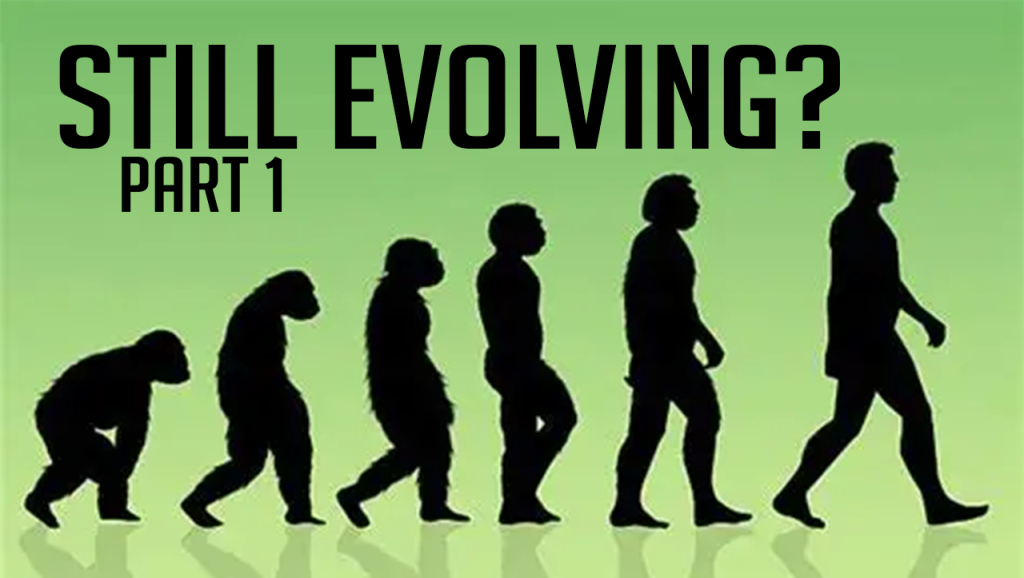
Are Humans Still Evolving? What a New Genetics Study Actually Shows
(Part 1 of 2)
A major new study just made headlines claiming that humans are still evolving. That we’ve changed dramatically in the last ten thousand years. That our skin, our immune systems, even our brains have been reshaped by natural selection since the end of the last ice age.
The article I read put it like this — and I’m quoting now — “we are not simply cavemen wearing suits; we are different beasts altogether.”
That’s a pretty striking claim. And as Christians, we need to ask the right question about a claim like that. Not, “Is it scary?” Not, “Does it threaten my faith?” The right question is simpler. The right question is, “Is it true? And what exactly is being claimed?”
Because here’s what I want you to see. There’s a quiet sleight of hand happening in the way this research is being reported. And once you see it, you’ll notice it everywhere — in nature documentaries, in science magazines, in your kid’s biology textbook. Once you see it, you can’t unsee it.
So let’s talk about what this study actually found, what it didn’t find, and why a Christian doesn’t have to be afraid of any of it.
WHAT THE STUDY ACTUALLY DID
Here’s the background. A team of researchers at Harvard, led by a scientist named Ali Akbari, published a paper in the journal Nature. They worked in the lab of David Reich, who is one of the leading figures in ancient DNA research in the world today. Whatever you think of his conclusions, the man’s lab is doing serious work.
What they did was remarkable. They analyzed ancient DNA from nearly sixteen thousand people who lived in Europe and western Asia over the last eighteen thousand years. Sixteen thousand people. Think about that. We’re talking about pulling genetic material out of bones and teeth recovered from archaeological sites — people who lived at the end of the ice age, people who lived through the rise of farming, people who lived during the Bronze Age, all the way up to the modern era.
And when they compared all that genetic data, they found something interesting. They identified four hundred seventy-nine specific places in the human genome where the genetic mix in the population shifted in a clear direction over time. Not random fluctuation. Real, sustained change.
What kinds of traits are we talking about? Skin color. Eye color. Resistance to certain diseases. Tolerance for milk. Susceptibility to celiac disease. And — this is where it gets controversial — they say they found shifts related to things like schizophrenia risk, bipolar disorder risk, and even traits associated with educational attainment and intelligence.
Now that last part — the cognitive stuff — even other geneticists are pumping the brakes on. A scientist named Iain Mathieson, who actually trained in the same lab, has publicly questioned whether the methods used can really separate genuine selection from random statistical noise. So even within the field, the cognitive findings are contested.
But let’s set that aside. Let’s grant the whole study. Let’s assume every finding is rock solid. The question I want to ask is, “What does this actually prove?”
THE WORD “EVOLUTION” IS DOING TWO JOBS
Here’s where the sleight of hand happens. And you have to listen carefully, because the word evolution gets used in two completely different ways, and most people don’t realize they’re switching between them.
The first way the word is used means small-scale change within a kind of creature. The mix of traits in a population shifts over time. Some traits become more common, others become less common. The classic example everybody learns in school is the moths in England — the peppered moths — that shifted from mostly light-colored to mostly dark-colored when the Industrial Revolution covered the trees in soot. The dark moths blended in better, so birds ate fewer of them, so they had more babies, so dark moths became more common.
Notice something. The dark moths were already there. The genes for dark coloring already existed. What changed was the proportion. Same species. Same kind of creature. Same moth at the end of the process as at the beginning. Just a different mix.
That’s the first way the word evolution gets used. Adaptation. Variation. Shifting proportions of traits that already exist within a kind of creature.
Now the second way the word gets used is dramatically different. The second way means the grand story — the story that says single-celled organisms became fish, fish became amphibians, amphibians became reptiles, reptiles became mammals, mammals became apes, apes became us. Different kinds of creatures emerging from earlier kinds. Brand-new body plans. Brand-new biological information appearing where it didn’t exist before.
Those are not the same claim. Those are not even close to the same claim. One is observable, testable, and frankly, obvious — you can see it happening with bacteria in a hospital developing resistance to antibiotics. The other is a sweeping historical narrative that requires you to extrapolate from small changes to enormous ones, and it raises huge questions about where the new genetic information would come from.
Here’s the trick. When a study like this comes out, it documents the first kind. The small-scale, within-the-kind variation. But it gets reported using the language of the second kind. As if proving that human skin color shifted in northern Europe somehow proves that your great-great-grandfather a thousand generations back was something other than human.
That’s the move. That’s the sleight of hand. And once you see it, you see it everywhere.
WHAT THE STUDY ACTUALLY FOUND VERSUS WHAT IT DIDN’T
So let me be very clear about what Akbari’s team actually documented.
Skin color shifts in populations that moved north into colder, darker climates. Lower sun exposure means less vitamin D, so populations with lighter skin had a survival advantage in those regions. Makes sense. Doesn’t change the fact that they’re still human.
Immune system changes in response to new diseases. Once people stopped living in small bands of foragers and started crowding into farming villages and eventually cities, they got hit with diseases that didn’t exist before — diseases that jumped from livestock, diseases that spread because of poor sanitation, diseases that traveled along trade routes. The people whose immune systems happened to handle those diseases better had more surviving children. Their genes spread. Makes sense. Doesn’t change the fact that they’re still human.
Lactose tolerance. Most adult mammals lose the ability to digest milk after weaning. But somewhere along the way, in populations that domesticated cattle and goats, a genetic variant emerged that let adults keep digesting milk their whole lives. That spread fast in dairy-farming cultures. Makes sense. Doesn’t change the fact that they’re still human.
Notice what’s missing from this list. The study did not document any human population growing a third arm. It did not document any population developing a fundamentally new organ. It did not document the emergence of a new species. It did not document the appearance of any genuinely new biological information that wasn’t already present in the human genome.
What it documented was the human genome doing exactly what the human genome was apparently designed to do — flex and adjust and adapt to wildly different environments, from the icy north to the deserts of the Near East to crowded cities full of new diseases.
If you wanted to design a creature that could fill the earth — a creature that could spread to every climate, every continent, every condition — you would build into that creature exactly the kind of adaptive flexibility this study is documenting. You would not need to make them into different beasts. You would build the flexibility in from the beginning.
Which, by the way, is exactly what Genesis chapter one says God did. He created humans and told them to fill the earth. Adam and Eve, by all the genetic evidence we have, carried in their genomes the latent diversity to produce every people group on this planet — every skin tone, every eye color, every body type, every blood type. Not because they were every type, but because the genetic potential for every type was already there.
That’s not a problem for the biblical account. That’s a stunning confirmation of the biblical account.
This ends Part 1 of 2-parts. Look for Part 2 next week

Lance is the founding and lead pastor of Calvary Chapel Oxnard where he has served since 1982. Lance & David Guzik co-pastored the church for six years before David planted a church in a nearby community.
Lance & his wife Lynn were married in 1980 and have three adult children and five grandchildren. Lance loves teaching the Bible, History, and Leadership. He holds Masters-of-Arts in Biblical Studies and Ministry.
Lance serves as a chaplain for both the Oxnard and Port Hueneme Police Departments and enjoys backpacking, wood-working, working out, gardening, home improvement projects, reading, and graphic design.
The popular Communio Sanctorum: History of the Christian Church podcast can be found in both audio and video at the Into His Image website along with a growing inventory of Lances teaching.