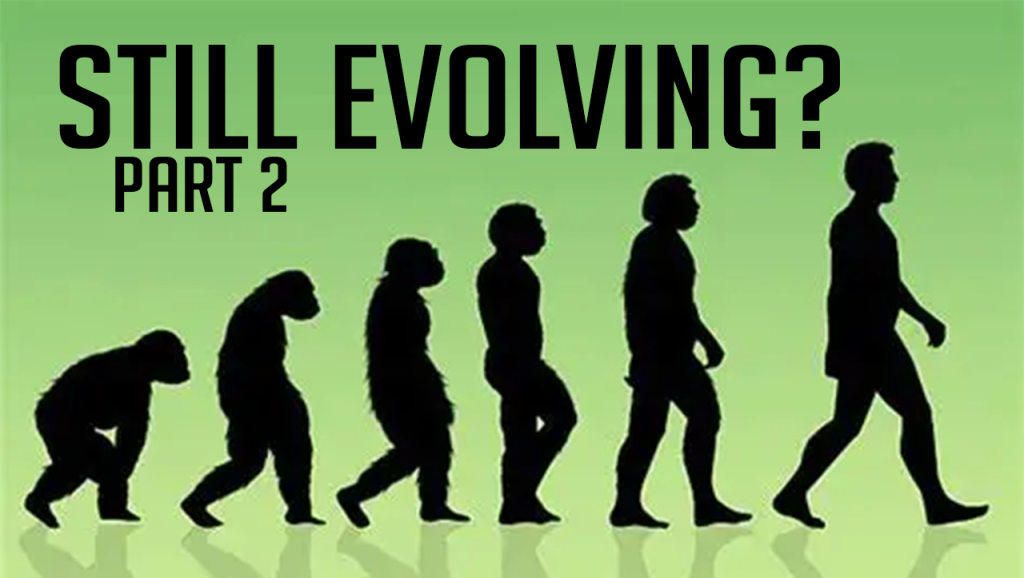
Are Humans Still Evolving? What a New Genetics Study Actually Shows
(Part 2 of 2 – Please read Part 1 for context. This article picks up where that left off)
“DIFFERENT BEASTS ALTOGETHER”
So why does the article use language like “we are different beasts altogether”? Why the dramatic framing?
Because the framing isn’t doing scientific work. The framing is doing philosophical work. And this is the most important thing I want you to understand today.
The actual data shows allele frequency shifts. That’s the technical term. It means the percentages of different gene variants in a population changed over time. That’s it. That’s the finding.
But “allele frequency shifts in West Eurasian populations between the Mesolithic and the modern era” doesn’t sell magazines. It doesn’t get clicks. It doesn’t shape culture.
So the finding gets dressed up in language that makes it sound like something much bigger. “We are different beasts altogether.” “Humans are still evolving.” “We are an adapting animal.”
Notice the word animal. Notice the word beast. Those words are not scientific descriptions. Those are philosophical commitments smuggled in alongside the data.
Because here’s the underlying claim being communicated, even if it’s never stated outright. The underlying claim is that you are nothing more than a biological accident. You are a meat machine that got reshuffled by environmental pressures. You have no fixed nature. You have no soul. You have no purpose beyond surviving and passing on your genes. You are clay that the environment is constantly remolding.
That’s not science. That’s a worldview. And it gets injected into the public conversation through articles like this one — not because the data demands it, but because the writer assumes it from the beginning.
WHY THIS MATTERS FOR THE FUTURE
I want to point out one more thing in this article, because I think this is where the rubber really meets the road for our generation.
Toward the end, the author writes that the modern world might turn out to be — and I’m quoting — “an evolutionary proving ground just as intense as the Bronze Age.” That declining birth rates, urban living, modern technology — all of these might be forcing genetic changes on humanity that will keep reshaping us.
Now read between the lines. If we accept that humans are nothing but malleable biology — if there’s no fixed human nature, no soul, no image of God — then what’s the natural next step?
The natural next step is, “Why wait for selection to do the work? Why not just engineer the changes directly?”
This is exactly the door transhumanism is trying to walk through. The argument goes like this. Humans have always been changing. Evolution has always been reshaping us. So genetic engineering, brain implants, merging with artificial intelligence, even uploading consciousness to computers — these aren’t violations of human nature. They’re just the next step in a process that’s been going on forever.
Do you see how powerful that argument becomes if you accept the framing of the article? If we really are just “different beasts” being reshaped by environmental pressures, then there’s nothing sacred to protect. There’s no fixed human dignity. There’s no image of God. There’s just biology that we now have the tools to take into our own hands.
That’s why this conversation matters. Not because a study about ancient DNA threatens the faith. It doesn’t. But because the worldview being smuggled in alongside the study has enormous consequences for how the next generation thinks about what it means to be human.
A CHRISTIAN RESPONSE
So how should a Christian respond to all this? Let me give you four points.
First, don’t be afraid of the data. The data is fine. Populations adapt to their environments. Allele frequencies shift over time. Skin color responds to UV exposure. Immune systems respond to disease pressure. None of that is a problem for the Bible. In fact, the Bible predicts it. After Noah’s flood, after the dispersion at Babel, populations spread out into wildly different climates and conditions. We would expect to see genetic adaptation. The data is showing us exactly what we’d expect to see.
Second, pay attention to the difference between data and interpretation. Notice when scientists are reporting findings and notice when they’re packaging those findings inside a worldview. Learn to peel one off the other. The skill of separating “here’s what we observed” from “here’s what it means” is one of the most important apologetics skills you can develop. Most of the time, when secular science seems to threaten the faith, the threat is in the interpretation, not the data.
Third, hold tight to the imago Dei. Genesis chapter one, verse twenty-seven. “So God created man in his own image, in the image of God he created him; male and female he created them.” That is the line that cannot move. Humans are not beasts. Humans are not animals with extra processing power. Humans are image-bearers — body and soul, made by God, loved by God, redeemable by God. Adaptation does not erase that. Genetic variation does not erase that. Even sin and the fall did not erase that, though they badly marred it. Christ came to restore it.
Fourth, be ready for the next conversation. The conversation about transhumanism, about genetic engineering, about merging humans with machines — that conversation is here. It’s already in your kid’s high school. It’s already on your nephew’s social media feed. The arguments for it are going to lean heavily on exactly the kind of framing this article uses. “Humans have always been changing.” “There’s no fixed human nature.” “Evolution never stopped — let’s just take the wheel.”
You need to be ready for that. You need to know how to gently and clearly say, “No, friend, that’s not what the data shows. That’s what someone wants you to think the data shows. There’s a difference.”
Finally …
A new study found that human populations have adapted in measurable ways over the last ten thousand years. That’s true. That’s interesting. That’s worth knowing.
But adaptation is not transformation into a different kind of creature. Adjustment within humanity is not evolution out of humanity. The headlines are dressing up small-scale variation in language designed to make you feel like the ground is shifting under your feet.
The ground is not shifting. The God who created us in His image, who knit us together in our mother’s womb, who knows the number of hairs on our head — that God has not changed. His image stamped on us has not changed. The dignity He gave us has not changed. Our purpose has not changed.
We are not different beasts. We never were beasts. We are image-bearers, fearfully and wonderfully made, called to know and love the One who made us.
And the genome’s beautiful flexibility — its ability to adjust to ice ages and deserts and cities and plagues — is one more piece of evidence that we are the work of a wise Designer, not the accident of a blind process.

Lance is the founding and lead pastor of Calvary Chapel Oxnard where he has served since 1982. Lance & David Guzik co-pastored the church for six years before David planted a church in a nearby community.
Lance & his wife Lynn were married in 1980 and have three adult children and five grandchildren. Lance loves teaching the Bible, History, and Leadership. He holds Masters-of-Arts in Biblical Studies and Ministry.
Lance serves as a chaplain for both the Oxnard and Port Hueneme Police Departments and enjoys backpacking, wood-working, working out, gardening, home improvement projects, reading, and graphic design.
The popular Communio Sanctorum: History of the Christian Church podcast can be found in both audio and video at the Into His Image website along with a growing inventory of Lances teaching.